
Thermogym: The Resilient Choice for corrosive environments Indoor Coils in Demanding Environments
Contents:
- Introduction
- Unrivaled External Corrosion Resistance: Built for Harsh Environments
- Corrosion Resistance and Service Durability
- PED Compliance and Certification Readiness
- Safety with Flammable Refrigerants in Indoor Systems
- Future-Proofing Against Regulatory Tightening
- Available Tube Sizes and Engineering Fit
- Conclusion
While most fan coils are made with copper tubes, but there are many occassions where you need the 316L tubes for specific uses.
In ordinary offices and hotels the traditional copper-tube/aluminum-fin coil is cheap, efficient, and easy to source, but there are whole categories of projects where copper tubes are a liability and stainless is the only sensible choice. Once you step into chloride-rich air, aggressive washdowns, or regulated hygiene, you specify the material as 316L and you don’t look back.
1. Unrivaled External Corrosion Resistance: Built for clean rooms Environments
The low-carbon grade minimizes sensitization at welds, takes a proper passivation, and, thanks to molybdenum, holds up against pitting and crevice corrosion that would destroy copper in the same duty. On the water side, 316L tolerates inhibited glycols, biocides, and occasional upsets in chemical treatment better than copper; on the air side, it survives condensate laden with salt, SO₂, ammonia, or bleach residues that would turn a copper tube bundle into a leaking sieve. In natatoriums, coastal hospitals, cruise ships, paper mills, fertilizer handling, battery plants, wineries, dairies, and pharma clean spaces, the tube decision is simple: make it 316L and sleep at night.
2. Fins of your choice to handle anything you can throw at them.
Then continue the rest of the unit is is possible to make the fins 316, tubes are 316L. Using plain 316 for the fins gives you an air-side surface that does not shed oxides or green stains, does not pit in salty condensate, and tolerates caustic or acidic cleaning solutions without turning chalky or perforating. You do sacrifice thermal conductivity compared to aluminum or copper fins, so you recover performance with more fin area, tighter fin pitch where fouling allows, higher face velocity, or simply a slightly larger coil. That trade is worth it in places where sanitation or corrosion resistance is mission-critical.
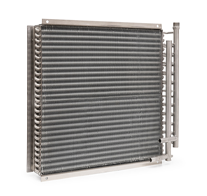
High pressure coil
Dairy and beverage procession
In a dairy or beverage plant the stainless fin face can be foamed, rinsed, and even steamed without fear of delamination or fin rot. In a winery or barrel room, stainless fins avoid flavor taint and stand up to SO₂ and tartaric residues. In pharmaceutical cleanrooms and biotech suites, auditors care about surfaces that don’t oxidize or shed; stainless fins on 316L tubes make validation easier and reduce headaches during repeated sanitization cycles. On ships and offshore platforms, stainless fins paired with 316L tubes shrug off salt fog and wet-dry cycling that would quickly pit aluminum; coatings help, but bare stainless avoids the coating pinholes and touch-up regime that inevitably follow.
3 Long life time.
There are design details that make this all work. Fin-to-tube attachment is done by mechanical expansion into fin collars. This lasts for decades and you don’t have to think about it.
Headers and return bends are welded stainless, with 316L filler and proper back purging to keep the internal welds clean; after fabrication, the assembly is fully pickled and passivated so the chromium oxide film is continuous. Drain pans, fasteners, and casings that share the wet airstream can also be made of stainless or properly isolated to avoid galvanic couples; keeping the entire wet end stainless removes the electrolyte-plus-dissimilar-metals problem that kills mixed-metal coils in harsh service.
Water treatment still matters: even 316L will suffer if you feed it oxygen-rich, low-pH, chloride-loaded water. Keep inhibitors up, control pH, and maintain glycol packages correctly. On the air side, push for even airflow, good filtration, and clean drains so condensate does not pool and concentrate salts at the fin-tube interface. When those basics are right, stainless coils run for decades.
Cost and weight go up with stainless, but lifecycle math usually favors it in the settings that truly need it. The first replacement of a corroded copper/aluminum coil in a caustic washdown room or salt-fog zone often costs more than the original stainless premium, not counting downtime, lost product, or contamination risk. Energy penalties are small when the coil is sized correctly; fan power or coil face area absorbs the conductivity difference, and you buy back reliability and hygiene. In mixed facilities you can still standardize on 316L tubes everywhere for leak resistance and choose stainless fins in the tough zones; if a space is clean, dry, and inland, an aluminum-fin coil may be fine, but the minute you face chlorides or sanitizers the stainless fin earns its keep. The practical rule set is straightforward. If regulators or auditors will ever ask about surfaces, if salt or chemicals will ever touch the coil, if a leak is unacceptable, specify 316L tubes and 316 fins. If none of those apply, copper tubes and aluminum fins remain economical in comfort cooling. The point is to match materials to environment, and in the demanding applications that drive failures and recalls, the answer is consistent: 316L for the tubes that hold the water, 316 for the fins that meet the air.
Another important consideration in specialized spaces is the effect of ultraviolet (UV) sanitization and electromagnetic flux. In hospitals, cleanrooms, food plants, and biotech facilities, UV lamps are sometimes mounted in or above coils to sterilize air and suppress biofilms. Stainless steel fins and 316L tubes are ideal under constant UV exposure because they do not chalk, craze, or embrittle the way plastics or coated aluminum surfaces can when bombarded with UV photons. A coil that relies on organic fin coatings for corrosion resistance will often degrade under strong UV, losing both its protection and its hygiene benefit. Bare stainless surfaces, by contrast, can withstand years of UV irradiation without shedding or discoloring, which keeps the coil both effective and audit-ready in sanitized environments.
In facilities with strong electromagnetic flux—antenna farms, radar rooms, MRI suites, or electron microscope labs—the choice of coil materials is just as critical. Copper fins can interfere with sensitive instruments or couple with high-field environments, generating unwanted noise or heating. Aluminum is less conductive but still problematic in some frequencies. Stainless steel fins, with their higher resistivity and non-magnetic grades, are far less disruptive, reducing electromagnetic interference and keeping sensitive measurements stable. For electron microscopes in particular, stability against stray magnetic fields is essential to image quality, and coils built with 316L tubes and plain stainless fins provide both corrosion resistance and electromagnetic quietness. In such spaces, the coil design becomes part of the electromagnetic hygiene of the room, proving again that the selection of stainless for both tubes and fins goes beyond corrosion—it also supports the integrity of scientific and electronic operations.
So when you have critial uses, don’t compromise, go for stainless steel tubes by Thermogym
No related products or energy posts found.